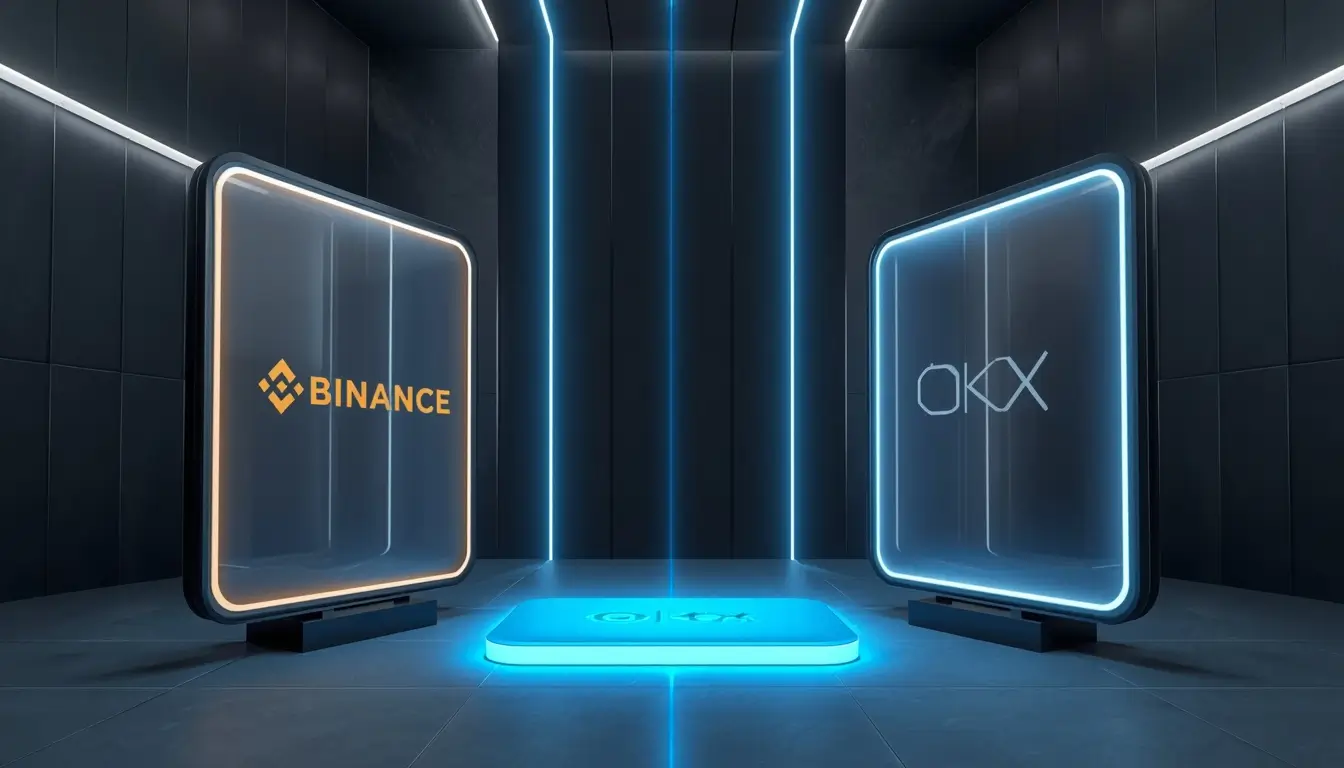
Direct Answer: Binance M-Score 8.8 remains the dominant venue for maximum order-book liquidity, altcoin depth, and global P2P fiat rails. However, OKX M-Score 8.5 holds a strong edge for derivatives traders, Web3 DeFi users, and security-conscious investors—offering slightly lower base spot maker fees (0.08%), an integrated non-custodial wallet, and a clean custody record free from major hot-wallet breaches.
Live Rating & Overview
| Platform | Binance | OKX |
|---|---|---|
| M-Score | 8.8 / 10 ★ Leader | 8.5 / 10 |
| Focus | CEX / DEX / WEB3 | CEX / Wallet / WEB3 |
| Highlights | The world's largest cryptocurrency exchange by trading volume, operating as a comprehensive Web3 ecosystem. Offers spot, margin, and futures trading for hundreds of digital assets, alongside native staking, P2P marketplaces, and decentralized wallet integrations. | A leading global cryptocurrency exchange and an advanced non-custodial Web3 gateway. Offers high-liquidity spot and derivatives trading alongside a powerful built-in multi-chain wallet with access to decentralized applications (dApps), NFT marketplaces, and cross-chain bridges. |
| Audit | Read Full Audit → | Read Full Audit → |
Technical Specs: Binance vs. OKX
| Feature | Binance | OKX |
|---|---|---|
| Best For | Maximum liquidity, altcoin variety, global P2P | Derivatives traders, API execution, Web3 DeFi |
| Base Spot Fees | 0.10% Maker / 0.10% Taker (0.075% with BNB) | 0.08% Maker / 0.10% Taker |
| Base Futures Fees | 0.02% Maker / 0.05% Taker (10% off with BNB) | 0.02% Maker / 0.05% Taker |
| Supported Assets | 400+ cryptocurrencies | 350+ cryptocurrencies |
| Web3 Wallet | Binance Web3 Wallet (MPC-based) | OKX Wallet (100+ chains, DEX & NFT aggregator) |
| Proof of Reserves | Monthly Merkle Tree + zk-SNARK verification | Monthly zk-STARK cryptographic audits (100%+ backing) |
Security Reality Check: The October 2026 Breach & Transparency
When choosing between two Tier-1 centralized exchanges, understanding counterparty risk and reserve transparency is critical—especially after the watershed security events of late 2026:
- Binance (October 2026 Hot-Wallet Breach): On October 29, 2026, attackers linked to North Korea’s Lazarus Group (TraderTraitor) compromised Binance’s hot wallets and drained roughly $6.3 billion in digital assets (including ~167,000 ETH and $1.6 billion in USDT) within 20 minutes—the largest crypto theft in history. Roughly $3 billion was rapidly frozen (including over $1.5 billion in USDT by Tether), and Binance committed its reserve fund and corporate balance sheet to fully reimburse affected users. While user balances were protected, the incident underscored the systemic risk of storing large funds on centralized hot infrastructure.
- OKX (Clean Custody Record & zk-STARK Audits): OKX has avoided major hot-wallet breaches and leads the industry in cryptographic Proof of Reserves—combining monthly Merkle Tree snapshots with zk-STARK proofs and public wallet disclosures so users can verify 100%+ on-chain backing independently.
Where Binance Wins
Binance remains the global liquidity leader across spot and derivatives order books. For large orders, tighter bid-ask spreads mean lower slippage than on almost any competing venue. In addition, Binance’s P2P marketplace supports over 100 local fiat currencies and hundreds of payment methods across Asia, Latin America, Africa, and Europe.
The world's largest cryptocurrency exchange by trading volume, operating as a comprehensive Web3 ecosystem. Offers spot, margin, and futures trading for hundreds of digital assets, alongside native staking, P2P marketplaces, and decentralized wallet integrations.
Where OKX Wins
OKX stands out for technical execution and on-chain integration. Its unified trading account allows traders to use multi-currency collateral across spot, margin, and perpetual futures seamlessly. Even more importantly, the built-in OKX Web3 Wallet supports over 100 blockchains with a native DEX aggregator, making it one of the most capable self-custody tools attached to a major exchange.
A leading global cryptocurrency exchange and an advanced non-custodial Web3 gateway. Offers high-liquidity spot and derivatives trading alongside a powerful built-in multi-chain wallet with access to decentralized applications (dApps), NFT marketplaces, and cross-chain bridges.
Frequently Asked Questions
Is OKX safer than Binance?
Following the October 2026 $6.3B hot-wallet breach on Binance—even with full user reimbursement—OKX currently holds an edge in custody track record and monthly zk-STARK Proof of Reserves transparency. However, for long-term savings, withdrawing funds to a hardware wallet like Trezor M-Score 8.9 or Ledger M-Score 7.8 remains far safer than keeping assets on any centralized exchange.
Which exchange has lower trading fees?
On standard entry-level accounts without token discounts, OKX has a slight edge on spot maker orders (0.08% vs. Binance’s 0.10%). However, if you hold BNB on Binance to pay trading fees, your spot rate drops to 0.075% and futures fees receive a 10% discount, making Binance slightly cheaper for active traders.
Are Binance and OKX available globally?
Both platforms serve millions of users across Asia, Europe, Latin America, and the Middle East, though available products (such as derivatives or specific stablecoins under EU MiCA rules) vary by country. Users in restricted jurisdictions such as the United States must use dedicated local entities (Binance.US or OKX US) with smaller asset catalogs.
Conclusion
There is no single winner for every trader. Choose Binance if you prioritize maximum order-book liquidity, the broadest selection of altcoin pairs, and deep local P2P fiat support. Choose OKX if you want lower base spot maker fees, a unified margin account, a cleaner custody record, and seamless access to DeFi through a top-tier built-in Web3 wallet.
Disclaimer: This comparison is for informational purposes only and does not constitute financial, investment, or trading advice. Digital assets and leveraged derivatives carry high risk. Manulik operates as an independent directory—we do not accept paid placements or affiliate commissions to alter our rankings.
Top-Rated Tools Related to This Guide
Automatically matched from our independent directory based on 4-pillar M-Score ratings (no paid placements):